Overview
The European External Action Service (EEAS) has released its third annual FIMI Threats Report, introducing a critical new analytical tool-the FIMI Exposure Matrix-to expose how authoritarian regimes like Russia and China are weaponising digital information to manipulate public opinion, interfere in democratic processes, and expand geopolitical influence.Key Takeaways
🔍 What is FIMI?
Foreign Information Manipulation and Interference (FIMI) refers to coordinated, deceptive online behaviour-often legal but harmful-by state and non-state actors aiming to destabilise societies, polarise communities, and undermine trust in democratic institutions.1. Global Trends in 2024
- 505 FIMI incidents involving 38,000 channels were tracked across 90 countries on 25 platforms.
- Ukraine, France, Germany, Moldova, and Africa’s Sahel region were primary targets.
- Elections were a key focus, with Russia targeting the European elections and China interfering in the Taiwanese elections.
- X (formerly Twitter) hosted 88% of detected FIMI activity.
Tactics Used
- Bot networks, impersonation, inauthentic news sites (e.g., Doppelgänger), and increasingly, AI-generated deepfakes and content.
- Localized content strategies tailored to regional events, languages, and narratives.
- Cross-platform coordination with amplification across Facebook, Telegram, TikTok, and YouTube.
2. The FIMI Exposure Matrix: A Game-Changer
A four-tiered classification system that maps the structure of influence operations:- State Official Channels – Direct government accounts.
- State-Controlled Outlets – Media outlets with overt state funding/control (e.g., RT, CGTN).
- State-Linked Channels – Covertly controlled or funded actors.
- State-Aligned Channels – Independent entities echoing state narratives without proven links.
3. Anatomy of Influence Operations
Using the Matrix, the report maps the vast FIMI architecture through network analysis, identifying:- Russian influence hubs like RT, Sputnik, and the Portal Kombat network.
- Chinese influence-for-hire operations using PR firms and inauthentic websites (e.g., Paperwall, HaiEnergy).
- Interactions between attributed and non-attributed channels that obscure the origin of content (information laundering).
4. Case Studies: Where FIMI Hits Hardest
🇲🇩 Moldova
- Russia used overt and covert assets to influence Moldova’s 2024 elections and EU referendum.
- Employed AI, impersonation, and payment schemes to spread anti-EU narratives.
- Created local fake news sites (e.g., Moldova24) and deepfakes targeting President Maia Sandu.
🌍 Sub-Saharan Africa
- Russia restructured its media strategy post-Prigozhin via the African Initiative, targeting Francophone and Sahel states.
- Amplified anti-Western, pro-Kremlin narratives while promoting Russia as a counterterrorism ally and anti-colonial partner.
- Used local languages, influencers, and both online and offline channels (e.g., training journalists) to spread content.
🇨🇳 China
- Leveraged PR firms and fake news portals to push state narratives globally.
- Targeted Taiwan’s elections and used influence-for-hire models like the VN Network.
- Suppressed critical voices through transnational repression and content laundering.
5. Strategic Responses
- The EU has launched sanctions (Dec 2024) and coordinated efforts with partners (G7, NATO) as part of its FIMI Toolbox.
- Emphasises a whole-of-society approach-from regulation to civil society empowerment.
- Calls for enhanced data access, anticipatory analysis, and support for fact-checkers, journalists, and researchers facing increasing threats.
Conclusion
FIMI is not just disinformation-it’s information warfare. It is embedded in the geopolitical strategies of authoritarian regimes and represents a growing hybrid threat. The EEAS’s FIMI Exposure Matrix marks a major step in systematically exposing, attributing, and countering this threat, but continued international cooperation, regulatory innovation, and support for the FIMI defender community are crucial to safeguarding democratic resilience.📘 For a deeper dive into the findings, methodologies, and case studies, read the full report by the European External Action Service (EEAS):
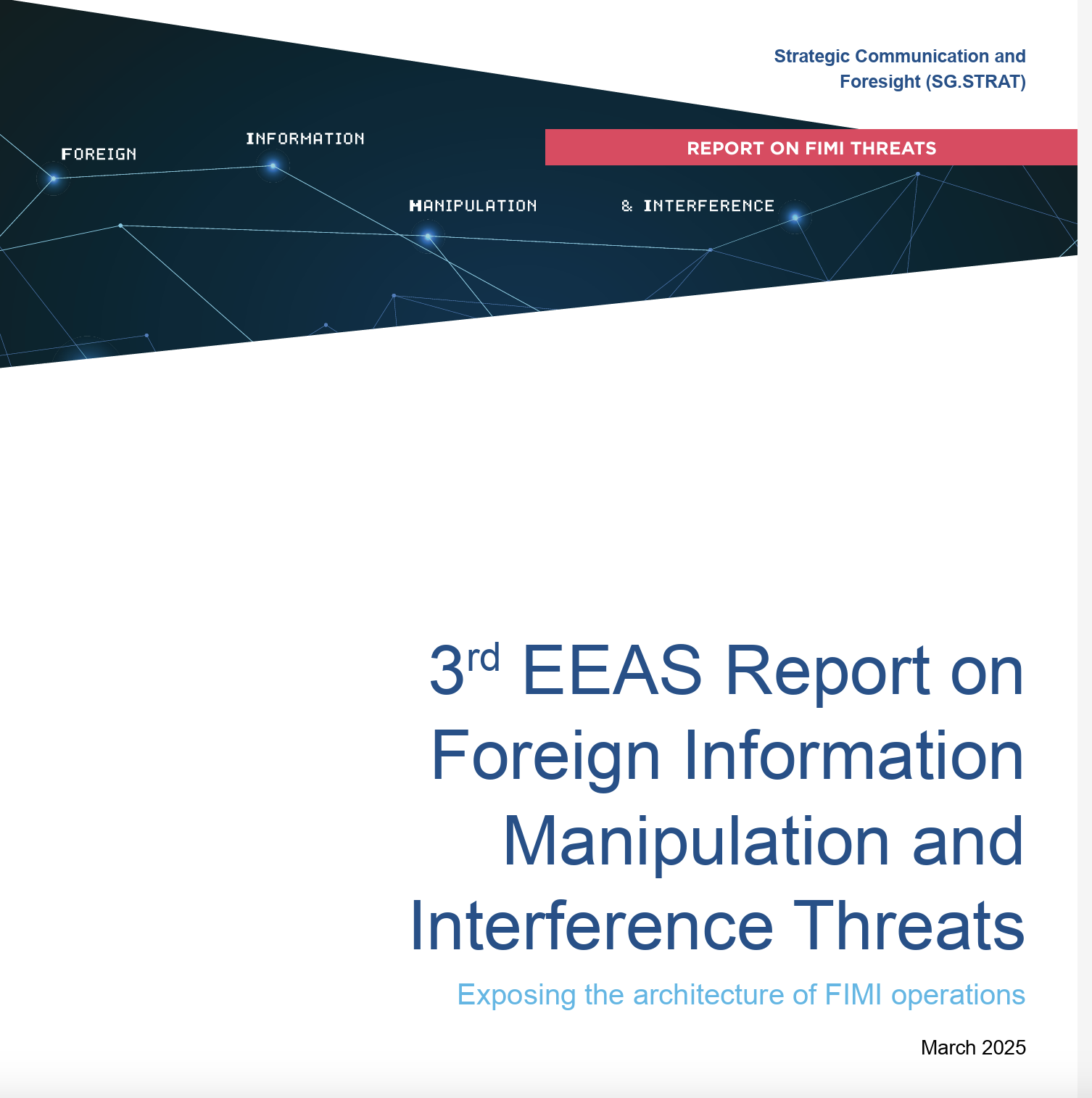
“3rd EEAS Report on Foreign Information Manipulation and Interference Threats – March 2025”
Authored by the Strategic Communication and Foresight Unit, European External Action Service (EEAS).
Access the full report

